
Friday, October 14, 2016

Monday, April 04, 2016
Ukraine's ascending star
This video reflects a reality of Ukrainian history that my friend Marsha J. Skrypuch and I discussed today.
She was telling me about the research she is doing for her next WWII-era novel, and reminded me that as recently as the middle of the 20th century, very few ethnic Ukrainians lived in the cities or even towns of what is now Ukraine.
How recent history has changed is that urban centres in Ukraine now are no longer populated primarily by occupying forces and/or re-settlers (with the sad and hopefully temporary exceptions of the Crimea and Donbas). Now, urban centres in Ukraine are populated by Ukrainians. Not necessarily ethnic Ukrainians, but with proud citizens of Ukraine, regardless of their ethnic heritage. And more and more of them speaking the native Ukrainian language.
I could ask if this is how a nation is born. The English word "nation" is the closest equivalent to the Ukrainian word "народ` (narod). But the Ukrainian word has so much more depth and breadth (just check out the list of synonyms on Google Translate) .
So to my mind, it is more accurate to say that this is how a state is born. The nation, it seems to me, was born long ago.
This video to me illustrates an astonishing change in Ukraine's self-identity, and rapidly growing maturity as a nation-state.
To all my native Ukrainian friends ... I stand in awe (and the greatest admiration) of all of you. Molodetz!
Слава Україні!
She was telling me about the research she is doing for her next WWII-era novel, and reminded me that as recently as the middle of the 20th century, very few ethnic Ukrainians lived in the cities or even towns of what is now Ukraine.
How recent history has changed is that urban centres in Ukraine now are no longer populated primarily by occupying forces and/or re-settlers (with the sad and hopefully temporary exceptions of the Crimea and Donbas). Now, urban centres in Ukraine are populated by Ukrainians. Not necessarily ethnic Ukrainians, but with proud citizens of Ukraine, regardless of their ethnic heritage. And more and more of them speaking the native Ukrainian language.
I could ask if this is how a nation is born. The English word "nation" is the closest equivalent to the Ukrainian word "народ` (narod). But the Ukrainian word has so much more depth and breadth (just check out the list of synonyms on Google Translate) .
So to my mind, it is more accurate to say that this is how a state is born. The nation, it seems to me, was born long ago.
This video to me illustrates an astonishing change in Ukraine's self-identity, and rapidly growing maturity as a nation-state.
To all my native Ukrainian friends ... I stand in awe (and the greatest admiration) of all of you. Molodetz!
Слава Україні!
Sunday, March 13, 2016
Journalist exposing Kremlin trolls comes under attack
An article about a journalist being attacked by Kremlin trolls for daring to expose them was recently published in the Sydney Morning Herald. It is chilling.
Finnish journalist Jessikka Aro worries that it's not only her coming under attack. She says that "trolls are having an unhealthy impact on freedom of speech and democracy more broadly."
"... ordinary Finns who are exposed to troll misinformation have 'told me that they have started to lose touch with what is true and what is not true ... for example, in the Ukraine crisis they don't know what is a fact and what's not, because trolls mess up the conversation.'
"Some of those attacking her say they are just exercising freedom of political speech. Aro has no time for that argument. In fact they are trying to suppress other people's free speech through aggression, she says.
...
"An EU official who has been studying Russian propaganda – and who spoke to Fairfax Media on condition of anonymity – says Aro's case is "quite extraordinary".
"I'm actually surprised this is happening in the EU," he says.
"The amount of resources being put into an attempt to bully Aro was remarkable. "Not only money but also people. The purpose: intimidation ... to kill the debate."
"However, Aro is far from the only victim, nor the only topic of pro-Russian trolling, misinformation and propaganda, the official says.
...
"..."the troll network is used to 'road-test' conspiracy theories, seeding six or seven competing pieces of propaganda or misinformation and letting the Darwinian world of online information exchange prove which is the hardiest – which is then republished by more conventional media. It's a system applied, for example, to the shooting down of Malaysia Airlines flight MH17 in 2014.
"'One of the biggest problems is we don't have a clue how much money they put into this,' the official says. 'We do not have clue how much media there are, how many people they target, how many people they reach. We can only guess from the results.
"'The aim is not to make you love Putin. The aim is to make you disbelieve anything. A disbelieving, fragile, unconscious audience is much easier to manipulate.'"
Read the full article here. It's an eye-opener.
Finnish journalist Jessikka Aro worries that it's not only her coming under attack. She says that "trolls are having an unhealthy impact on freedom of speech and democracy more broadly."
"... ordinary Finns who are exposed to troll misinformation have 'told me that they have started to lose touch with what is true and what is not true ... for example, in the Ukraine crisis they don't know what is a fact and what's not, because trolls mess up the conversation.'
"Some of those attacking her say they are just exercising freedom of political speech. Aro has no time for that argument. In fact they are trying to suppress other people's free speech through aggression, she says.
...
"An EU official who has been studying Russian propaganda – and who spoke to Fairfax Media on condition of anonymity – says Aro's case is "quite extraordinary".
"I'm actually surprised this is happening in the EU," he says.
"The amount of resources being put into an attempt to bully Aro was remarkable. "Not only money but also people. The purpose: intimidation ... to kill the debate."
"However, Aro is far from the only victim, nor the only topic of pro-Russian trolling, misinformation and propaganda, the official says.
...
"..."the troll network is used to 'road-test' conspiracy theories, seeding six or seven competing pieces of propaganda or misinformation and letting the Darwinian world of online information exchange prove which is the hardiest – which is then republished by more conventional media. It's a system applied, for example, to the shooting down of Malaysia Airlines flight MH17 in 2014.
"'One of the biggest problems is we don't have a clue how much money they put into this,' the official says. 'We do not have clue how much media there are, how many people they target, how many people they reach. We can only guess from the results.
"'The aim is not to make you love Putin. The aim is to make you disbelieve anything. A disbelieving, fragile, unconscious audience is much easier to manipulate.'"
Read the full article here. It's an eye-opener.
Tuesday, February 09, 2016
Who will really end this war
(Ras)Putin’s “popularity” appears to be coming down like a house of cards. This despite his control of the Russia's media.
I was surprised to see this video of Russian people protesting in Moscow ... and not a little alarmed at the reason one Muscovite said that they are not protesting in larger numbers.
While the collapse of the oil market and the ruble may eventually bring the Russian mafia down, in the process it is bringing misery to millions who are mere pawns in high-stakes games of international finance, as we see clearly in the above video.
There are many other reports about the fallout of Putin's demagoguery in articles like this one about shopkeepers and mall owners losing their livlihoods at the hands of the state, and this one about Russian-owned gas stations closing in Poland and the Baltics.
There is plenty of misery to go around at the hands of the Putin regime, and I do feel sorry for the Russian people, but only to an extent. Some see the light but the vast majority, if the polls are to be believed, don't.
They trust a mafia boss to deliver a decent standard of living, as this video clearly illustrates.
They believe that Ukrainians are “fascists” for wanting a better life than what they could have under Kremlin lackeys.
They refuse to believe their own friends and relatives in Ukraine who tell them life is vastly different from what the Russian state media tells them.
So, now they are reaping the reward of their blind faith in a moneyed, criminal egomaniac. And, perhaps, in their own egos.
But will they eventually face reality? Or will they look for scapegoats, as happened in Nazi Germany?
As for the mafia-run government they still trust, how likely is it that Putin & Co. will go down quietly, much less alone?
The reality is that (Ras)Putin will cause as much damage as he can trying to hold on to his ill-gotten gains and position of privilege. Sort of a post-modern twist on the "scorched earth" tactic the Russians have used extensively in their imperialist ambitions, especially against Ukraine, most recently by Stalin in WWII.
But the western military-industrial complex won’t allow the global economy, to crash. Recently financial gurus have been opining about how "war is good for the economy."
So I'd say there's a good chance that another world war is on the horizon. And with nukes in the hands of rogue states it doesn't bode well for humanity.
Still there is hope. According to this recent article, mercenaries fighting for Putin are starting to see the light.
This to me is the only hope for war to end, along with the misery it brings.
Not so much that people merely stop fighting, because that just makes it easier for tyrants to continue their oppression and totalitarianism. Which is what Ukrainians have been fighting for centuries, and still are fighting... mostly alone as they always have been.
Rolling over and giving in may end the use of heavy weapons, but it won't end the oppression of tyrants.
No. War will not end until people stop allowing themselves to be used as instruments of evil. This calls for some hard decisions, honest introspection, and sacrificing of egos on an individual, personal basis. No finger-pointing or assigning blame ... except to the person in the mirror.
Is the human race up to it?
Well, we can only hope.
I was surprised to see this video of Russian people protesting in Moscow ... and not a little alarmed at the reason one Muscovite said that they are not protesting in larger numbers.
While the collapse of the oil market and the ruble may eventually bring the Russian mafia down, in the process it is bringing misery to millions who are mere pawns in high-stakes games of international finance, as we see clearly in the above video.
There are many other reports about the fallout of Putin's demagoguery in articles like this one about shopkeepers and mall owners losing their livlihoods at the hands of the state, and this one about Russian-owned gas stations closing in Poland and the Baltics.
There is plenty of misery to go around at the hands of the Putin regime, and I do feel sorry for the Russian people, but only to an extent. Some see the light but the vast majority, if the polls are to be believed, don't.
They trust a mafia boss to deliver a decent standard of living, as this video clearly illustrates.
They believe that Ukrainians are “fascists” for wanting a better life than what they could have under Kremlin lackeys.
They refuse to believe their own friends and relatives in Ukraine who tell them life is vastly different from what the Russian state media tells them.
So, now they are reaping the reward of their blind faith in a moneyed, criminal egomaniac. And, perhaps, in their own egos.
But will they eventually face reality? Or will they look for scapegoats, as happened in Nazi Germany?
As for the mafia-run government they still trust, how likely is it that Putin & Co. will go down quietly, much less alone?
The reality is that (Ras)Putin will cause as much damage as he can trying to hold on to his ill-gotten gains and position of privilege. Sort of a post-modern twist on the "scorched earth" tactic the Russians have used extensively in their imperialist ambitions, especially against Ukraine, most recently by Stalin in WWII.
But the western military-industrial complex won’t allow the global economy, to crash. Recently financial gurus have been opining about how "war is good for the economy."
So I'd say there's a good chance that another world war is on the horizon. And with nukes in the hands of rogue states it doesn't bode well for humanity.
Still there is hope. According to this recent article, mercenaries fighting for Putin are starting to see the light.
Former Russian insurgent calls those whom he was fighting against in the Donbas patriots of his country and says he regrets coming to Ukraine with weapons.
This was stated by former Donbas militant Alexey in an interview with Russian website Rosbalt...
"I can only say of the armed forces of Ukraine, those poor creatures who had been drafted to the army and forced to protect their Fatherland - they are good eggs and patriots. I really regret about having to shoot at them. My enemies are not there! That's the TV that made me think so.
"It's a pity that I'm not the only one deceived by TV propaganda. It's a good thing that many of those who had been there started to realize that's not our war, that's the war of other people and their interests. Many of my comrades realized that we had been deceived and betrayed."
Source: http://en.censor.net.ua/n370116
Not so much that people merely stop fighting, because that just makes it easier for tyrants to continue their oppression and totalitarianism. Which is what Ukrainians have been fighting for centuries, and still are fighting... mostly alone as they always have been.
Rolling over and giving in may end the use of heavy weapons, but it won't end the oppression of tyrants.
No. War will not end until people stop allowing themselves to be used as instruments of evil. This calls for some hard decisions, honest introspection, and sacrificing of egos on an individual, personal basis. No finger-pointing or assigning blame ... except to the person in the mirror.
Is the human race up to it?
Well, we can only hope.
Monday, February 01, 2016
Ukrainians being deported from Canada
Recently I came across an appalling story about a Ukrainian immigrant family that is being deported from Canada.
This young family, the Vasileyevs, came to Canada in 2012. Since then, they they have been going through all the hoops involved in the immigration process, following all the rules to apply for Canadian citizenship.
But now they are about to be deported. From Canada.
Many things about this story trouble me, not least of all that so far it is not getting much coverage in the media.
The only story on this family's woes was published in the Winnipeg Sun. It was reprinted in Canoe News and referenced by The Rebel in a brief video that takes a poke at the current Trudeau government.
How this family is being treated, by Canadian bureaucrats and Canadian media alike, is so wrong.
There is corruption in bureaucratic ranks that allows this sort of thing to happen, regardless of which political party is currently in power in Ottawa.
Yet no one investigates, no one speaks up, no one pays any attention at all until there is some political gain to be made.
Being in the media myself (albeit on the outer fringes), I can't blame The Rebel for taking advantage of this family's predicament. It is just doing what comes naturally in the media biz, which is more cut-throat than most, and is fast becoming as politically polarized as it is south of the border.
That said, it is an utter disgrace that the media ignores stories like these until they do become partisan issues. At which point all those left standing in the spotlight can see fit to do is point fingers at their political opponents.(Whatever happened to the meme of "comforting the afflicted and afflicting the comfortable?")
In my humble opinion, it is beyond disingenuous, and shameful, to play partisan politics with such travesties. Because while those of us living our lives of comfort and privilege enjoy the luxury of playing partisan politics (or not), hardworking, innocent, good people who just want to have a decent life keep getting screwed.
As for the few who will bother to watch the video and read the article, you can bet yer boots there are some among them who will soon be arguing about how either the current government or the previous government is to blame for this family's plight.
Meanwhile, nothing will be done to help the Vasileyevs, and they will return to their country with less than flattering accounts about ours.
Sadly, few Canadians, including those of Ukrainian extraction, seem to be very concerned about that. But hey, there are obviously more pressing matters (like arguing partisan politics) than helping people who are being victimized by incompetent and/or corrupt bureaucrats.
This young family, the Vasileyevs, came to Canada in 2012. Since then, they they have been going through all the hoops involved in the immigration process, following all the rules to apply for Canadian citizenship.
But now they are about to be deported. From Canada.
Many things about this story trouble me, not least of all that so far it is not getting much coverage in the media.
The only story on this family's woes was published in the Winnipeg Sun. It was reprinted in Canoe News and referenced by The Rebel in a brief video that takes a poke at the current Trudeau government.
How this family is being treated, by Canadian bureaucrats and Canadian media alike, is so wrong.
There is corruption in bureaucratic ranks that allows this sort of thing to happen, regardless of which political party is currently in power in Ottawa.
Yet no one investigates, no one speaks up, no one pays any attention at all until there is some political gain to be made.
Being in the media myself (albeit on the outer fringes), I can't blame The Rebel for taking advantage of this family's predicament. It is just doing what comes naturally in the media biz, which is more cut-throat than most, and is fast becoming as politically polarized as it is south of the border.
That said, it is an utter disgrace that the media ignores stories like these until they do become partisan issues. At which point all those left standing in the spotlight can see fit to do is point fingers at their political opponents.(Whatever happened to the meme of "comforting the afflicted and afflicting the comfortable?")
In my humble opinion, it is beyond disingenuous, and shameful, to play partisan politics with such travesties. Because while those of us living our lives of comfort and privilege enjoy the luxury of playing partisan politics (or not), hardworking, innocent, good people who just want to have a decent life keep getting screwed.
Meanwhile, nothing will be done to help the Vasileyevs, and they will return to their country with less than flattering accounts about ours.
Sadly, few Canadians, including those of Ukrainian extraction, seem to be very concerned about that. But hey, there are obviously more pressing matters (like arguing partisan politics) than helping people who are being victimized by incompetent and/or corrupt bureaucrats.
Saturday, January 02, 2016
Donetsk Airport
Ludwig van Beethoven's Ode to Joy performed at Donetsk Airport on 1 March 2014.This song is considered to be the "anthem of Europe."
Just weeks after this performance, Russia dispatched its proxies in Donetsk, who attacked this beautiful new building with the intention of destroying it. This is what "Russkie Mir" (Russian peace) looks like. Any wonder Ukrainians are fighting back?
The Ukrainians who defended their airport against foreign aggressors were nicknamed "Cyborgs" because they continued to outwit the Russian aggressors and impeded their progress in occupying Ukrainian territory.
I was honoured to visit a wounded Ukrainian "Cyborg" in Kyiv last spring. His story is very inspiring. If you haven't seen my video with footage of that visit, check it out here.
If you like it, please leave a comment, here and/or on YouTube. I have more photos and footage I'd like to share from that and previous trips in video, so I'd appreciate your feedback to help me make them as interesting and informative as possible.
Just weeks after this performance, Russia dispatched its proxies in Donetsk, who attacked this beautiful new building with the intention of destroying it. This is what "Russkie Mir" (Russian peace) looks like. Any wonder Ukrainians are fighting back?
The Ukrainians who defended their airport against foreign aggressors were nicknamed "Cyborgs" because they continued to outwit the Russian aggressors and impeded their progress in occupying Ukrainian territory.
I was honoured to visit a wounded Ukrainian "Cyborg" in Kyiv last spring. His story is very inspiring. If you haven't seen my video with footage of that visit, check it out here.
If you like it, please leave a comment, here and/or on YouTube. I have more photos and footage I'd like to share from that and previous trips in video, so I'd appreciate your feedback to help me make them as interesting and informative as possible.
Sunday, December 27, 2015
Song about Heroes of Ukraine in Donbass
Another gorgeous tune from the Ukrainian front.
Courtesy Orest in Odesa.
Courtesy Orest in Odesa.
Tuesday, December 22, 2015
Ukraine's 21st Century struggle for independence
While watching one of the wonderful, breath-taking and thought-provoking videos out there these days, a couple of things occurred to me.
First, that the dance steps in Ukrainian dance, in particular of the men, were developed with more practical purposes than for entertaining audiences on a stage.
They were, literally, moves designed to save a solder's life and for defeating a murderous enemy.
In the last half of the 20th century, and the first couple of decades of the 21st, the origins of the dance moves were but a distant memory, interesting footnotes in the history of Ukrainian dance.
Now of course, the circumstances that led to the development of those dance moves are no longer a distant memory, but today's stark reality.
Things have changed tho.
So my second thought is how today's Ukrainian freedom fighters will be mythologized long after we're all gone from this earth.
Hand to hand combat is pretty much a thing of the past now, thanks to the horrible weaponry developed in the last century. So intimidating posturing and clever kicks won't be of any use to today's kozaky fighting for Ukraine's freedom.
With the resurgence of folkloric symbols and musical styles, probably the dance moves will remain, albeit modified somewhat by modern choreography.
But the rest of it ... the songs, the symbolism, and the sentiments ... these should be recorded for posterity.
It's a different world, and not just because of technology. It's the attitudes and mindsets that technology empowered.
I believe in my heart of hearts that Ukraine may, for the first time in centuries, be able to break the yoke of foreign oppression, once and for all.
So we should all chronicle this time in our lives.
We should keep meticulous records, digital or analogue (or both), for future generations to understand better than we ourselves do, being in the middle of it with only an eye of the storm view.
Perhaps if, with details chronicles and records, we can help them step back in time, we can help them avoid the mistakes that we have made, and are bound to make before this is all over.
I'd be interested to see if this video inspires you as it did me. Enjoy. Lyrics and translation below.
Їхали козаки, їхали по полю
І лунала пісня про їхнюю долю.
Про їхнюю долю, про справжнюю волю.
Їхали козаки, їхали по полю...
Cossacks rode, rode on the field
And the song was heard about their fate.
About their fate, and about the price of freedom.
The Cossacks were riding, to the battlefield ...
Їхали козаки та й пісню співали.
Про те, як любили і як воювали
За рідную землю, за батьків і друзів,
І за спів дівочий, що дзвенить у лузі...
The Cossacks rode, singing songs.
About learning to love and how to fight
For their native land, for family and friends,
And the songs of their sweethearts rang throughout the meadows.
Ой, у лузі-лузі тая пісня ллється,
А дівоче серце, як пташина, б'ється...
Віддала кохання хлопцю молодому
Їхали козаки, їхали додому...
Oh, in the meadow a song flows
And a maiden's heart beats like a bird’s wings,
Because she gave her love to a young man.
The Cossacks were riding, coming home ...
First, that the dance steps in Ukrainian dance, in particular of the men, were developed with more practical purposes than for entertaining audiences on a stage.
They were, literally, moves designed to save a solder's life and for defeating a murderous enemy.
In the last half of the 20th century, and the first couple of decades of the 21st, the origins of the dance moves were but a distant memory, interesting footnotes in the history of Ukrainian dance.
Now of course, the circumstances that led to the development of those dance moves are no longer a distant memory, but today's stark reality.
Things have changed tho.
So my second thought is how today's Ukrainian freedom fighters will be mythologized long after we're all gone from this earth.
Hand to hand combat is pretty much a thing of the past now, thanks to the horrible weaponry developed in the last century. So intimidating posturing and clever kicks won't be of any use to today's kozaky fighting for Ukraine's freedom.
With the resurgence of folkloric symbols and musical styles, probably the dance moves will remain, albeit modified somewhat by modern choreography.
But the rest of it ... the songs, the symbolism, and the sentiments ... these should be recorded for posterity.
It's a different world, and not just because of technology. It's the attitudes and mindsets that technology empowered.
I believe in my heart of hearts that Ukraine may, for the first time in centuries, be able to break the yoke of foreign oppression, once and for all.
So we should all chronicle this time in our lives.
We should keep meticulous records, digital or analogue (or both), for future generations to understand better than we ourselves do, being in the middle of it with only an eye of the storm view.
Perhaps if, with details chronicles and records, we can help them step back in time, we can help them avoid the mistakes that we have made, and are bound to make before this is all over.
I'd be interested to see if this video inspires you as it did me. Enjoy. Lyrics and translation below.
Їхали козаки, їхали по полю
І лунала пісня про їхнюю долю.
Про їхнюю долю, про справжнюю волю.
Їхали козаки, їхали по полю...
Cossacks rode, rode on the field
And the song was heard about their fate.
About their fate, and about the price of freedom.
The Cossacks were riding, to the battlefield ...
Їхали козаки та й пісню співали.
Про те, як любили і як воювали
За рідную землю, за батьків і друзів,
І за спів дівочий, що дзвенить у лузі...
The Cossacks rode, singing songs.
About learning to love and how to fight
For their native land, for family and friends,
And the songs of their sweethearts rang throughout the meadows.
Ой, у лузі-лузі тая пісня ллється,
А дівоче серце, як пташина, б'ється...
Віддала кохання хлопцю молодому
Їхали козаки, їхали додому...
Oh, in the meadow a song flows
And a maiden's heart beats like a bird’s wings,
Because she gave her love to a young man.
The Cossacks were riding, coming home ...
Monday, December 21, 2015
Polish rock group dedicates song to Ukraine's freedom fighters
This morning I received a Skype message that tugged (well, tore) at my heart.
It was from Orest, in Ukraine. He originally emailed me a few months back, soliciting support for his charity, and we ended up connecting on Skype.
His English and my Ukrainian are at about par, so our conversation was a bit rough around the edges.
However, this time I could understand him just fine.
He shared a song with me, and this message:
In Ukrainian:
In the video below, the young man speaking before the song starts reminds me very much of a "Cyborg" I visited in a Kyiv hospital last spring. His name is Vadym. He was caught in an ambush during a real-life raid in Debaltseve. He survived, fortunately, albeit without his arm and both legs.
I'll share his story here soon. In the meantime, enjoy the song that Orest sent, in memory of those who did not survive the real-life raids unleashed on Ukraine by their Russian "brothers."
The song is Біля Тополі - Near the Poplar, by Polish group Enej (Aneas) joined by popular Ukrainian artist Taras Chubai.
Слава Україні ... Слава героїм!
It was from Orest, in Ukraine. He originally emailed me a few months back, soliciting support for his charity, and we ended up connecting on Skype.
His English and my Ukrainian are at about par, so our conversation was a bit rough around the edges.
However, this time I could understand him just fine.
He shared a song with me, and this message:
In Ukrainian:
І крилами лелеки, повернуться живі!English translation:
Мати, син, калина, лелека - святі речі для кожного українця.
Слухаючи цю пісню нагортається сльоза.
Пісня "Біля тополі" з документального фільму "Рейд" Відомий польський гурт Enej присвятим воїнам, що загинули за свободу та незалежність України, пісню.
And on the wings of a stork, return alive!Having never heard of this film, I decided to see what I could find out about it. What I found out surprised me ... Raid is about the popular video game World of Warfare.
Mother, son, kalyna, the stork – these are sacred things to all Ukrainiansю
This song will bring tears to your eyes.
It is called "Near the Poplar" from the documentary film "Raid."
The famous Polish group Enej (Aeneas) dedicated this song to the soldiers who died fighting for the freedom and independence of Ukraine.
In the video below, the young man speaking before the song starts reminds me very much of a "Cyborg" I visited in a Kyiv hospital last spring. His name is Vadym. He was caught in an ambush during a real-life raid in Debaltseve. He survived, fortunately, albeit without his arm and both legs.
I'll share his story here soon. In the meantime, enjoy the song that Orest sent, in memory of those who did not survive the real-life raids unleashed on Ukraine by their Russian "brothers."
The song is Біля Тополі - Near the Poplar, by Polish group Enej (Aneas) joined by popular Ukrainian artist Taras Chubai.
Слава Україні ... Слава героїм!
Saturday, July 04, 2015
This week on Nash Holos Ukrainian Roots Radio
All three weekly editions of Nash Holos Ukrainian Roots are unique ... different tunes, news stories, proverbs and features. So check them all out!
On this week's 2-hour live Nanaimo Edition - July 1, 2015 Canada Day Special
Ukrainian Food Flair: Chilled borsch • Ukrainian Jewish Heritage: Ukrainian town of Brody • News from Ukraine (courtesy Ukraine Today) • Feature Interview: Taras Kulish of Hope Worldwide Canada, on the work being done to help children and their parents cope with post-traumatic stress disorder caused by the war in eastern Ukraine • Latest news from Ukraine (courtesy Ukraine Today) • Ukrainian proverb • Great Ukrainian music by: Dumka • Shoom • Dunai • Borsch Eaters • Boris Sichon • Kubasonics • Ron Hynes • Zubrivka • Sloohai • Cheremshyna • Millenia • Steven Chwok • Homin • Canadian Rhythm Masters
On this week's International PCJ Radio Edition - July 3-6, 2015:
Ukrainian Jewish Heritage: Lidia Kotliarevsky • Latest News from Ukraine (courtesy Ukraine Today) • Ukrainian Christian Heritage: Fr. Theo Machinsky on Invan Kupala • Dunai • Yulia Donchenko • Milla Jovovich • Cheremshyna • Kobza • Luhansky Kozaky • Komy Vnyz • By Request Band
On today's Vancouver edition - July 4, 2015:
Feature Interview: Taras Kulish with Hope Worldwide Canada on a groundbreaking new project dealing with PTSD in Ukraine (edited for rebroadcast) • Latest News from Ukraine (courtesy Ukraine Today) • Ukrainian Christian Heritage: Наші Свяащені Традіції with Father Theo Machinsky on Ivana Kupalo • Proverb of the Weeks • Great Ukrainian Music with a musical nod to our American listeners celebrating Independence Day. Artists aired on this week's Vancouver edition: Dunai • Darka & Slavko • Anne Pleskach & Bill Shcherbatiuk • Trembita • High Profile • Ambrose Brothers
Links to podcasts of all three editions at the Nash Holos website!
On this week's 2-hour live Nanaimo Edition - July 1, 2015 Canada Day Special
Ukrainian Food Flair: Chilled borsch • Ukrainian Jewish Heritage: Ukrainian town of Brody • News from Ukraine (courtesy Ukraine Today) • Feature Interview: Taras Kulish of Hope Worldwide Canada, on the work being done to help children and their parents cope with post-traumatic stress disorder caused by the war in eastern Ukraine • Latest news from Ukraine (courtesy Ukraine Today) • Ukrainian proverb • Great Ukrainian music by: Dumka • Shoom • Dunai • Borsch Eaters • Boris Sichon • Kubasonics • Ron Hynes • Zubrivka • Sloohai • Cheremshyna • Millenia • Steven Chwok • Homin • Canadian Rhythm Masters
On this week's International PCJ Radio Edition - July 3-6, 2015:
Ukrainian Jewish Heritage: Lidia Kotliarevsky • Latest News from Ukraine (courtesy Ukraine Today) • Ukrainian Christian Heritage: Fr. Theo Machinsky on Invan Kupala • Dunai • Yulia Donchenko • Milla Jovovich • Cheremshyna • Kobza • Luhansky Kozaky • Komy Vnyz • By Request Band
On today's Vancouver edition - July 4, 2015:
Feature Interview: Taras Kulish with Hope Worldwide Canada on a groundbreaking new project dealing with PTSD in Ukraine (edited for rebroadcast) • Latest News from Ukraine (courtesy Ukraine Today) • Ukrainian Christian Heritage: Наші Свяащені Традіції with Father Theo Machinsky on Ivana Kupalo • Proverb of the Weeks • Great Ukrainian Music with a musical nod to our American listeners celebrating Independence Day. Artists aired on this week's Vancouver edition: Dunai • Darka & Slavko • Anne Pleskach & Bill Shcherbatiuk • Trembita • High Profile • Ambrose Brothers
Links to podcasts of all three editions at the Nash Holos website!
Tuesday, June 30, 2015
Meeting Crimean Tatars in Ukraine
While in Lviv, I had the great privilege to spend time with two women from Crimea – one a Tatar, one Ukrainian.
Dr. Gulnara Bekirova was one of the speakers at the UJE conference in Kyiv. She is with the Special Kurultai Commission for the Research of Crimean Tatar Genocide, Ukraine. She spoke (in Russian btw, with no ill effects) during the session entitled The ‘Traitor Nation’and the Destruction of the Crimean Tatar Civilization.
The other was her friend who survived deportation to the Urals. Dr. Bekirova’s friend joined us in the lobby of the Swiss Hotel, where the UJE entourage was staying. Much of the conversation was private and personal ... including finding uncanny personal connections. (She even thought I looked familiar!) So much for the proverbial "six degrees of separation." For anyone with a Ukrainian connection anyway, it's usually two or three at most!
Earlier, I had a rare opportunity to chat with Dr. Bekirova over breakfast. There was a bit of a language barrier as she speaks “Surzhyk” (a mixture of Russian and Ukrainian) and I speak просто (kitchen) Ukrainian. I bitterly resent the language barrier, but appreciate learning what I did from that discussion, and the meeting with her friend later. Fortunately our intrepid leader, Raya, joined us at breakfast and kindly translated when I got stuck.
Dr. Bekirova told us that life in Crimea is dangerous now—for everyone, but especially for ethnic Ukrainians and Crimean Tatars. She lives in Simferopol, Crimea and publishes children’s books in the Crimean Tatar language, so that the language and culture survive. So far she has managed to stay out of the cross hairs of the occupying Russians.
When the occupation began and the Ukrainian army was still in Crimea, the Tatars brought the soldiers food and other supplies, and begged them not to leave Crimea, but to stay and protect them. As we know, the Ukrainian forces were overpowered by the Russian army and Putin’s green men, which are now occupying the peninsula.
But, Dr. Bekirova said: “We didn’t bow down to the Russians, and we never will. Crimean Tatars love their land, Crimea... and Ukraine, and want to belong to Ukraine.”
She told us that there are only about 600 Ukrainians left in Crimea. Those she knows are too afraid to speak Ukrainian in public.
When I visited Crimea with family members on a tour in 2008, I recall that it was rare to hear Ukrainian spoken... unless you initiated the conversation. Then it was all smiles and the Ukrainian came out! I did detect a bit of nervousness in the people we spoke Ukrainian with, but not outright fear. Perhaps from 2008 till 2014, some progress had been made in Ukrainian language rights in Crimea. But Putin has obviously reversed that.
During breakfast and over coffee we spoke about her work as a children's publisher and cultural activist, and what we learned from her presentation at the conference in Kyiv about the little-known genocide of Crimean Tatars in 1946.
(Funny how many of Stalin's genocides are still unknown in the 21st century. A person could be forgiven for wondering if it's a case of error of omission —or deliberate oversight. Fortunately, the information is out there, at least for those interested and determined enough to search for it.)
At one point she said how nice it would be to have a similar conference in Crimea. I found that quite surprising, given the situation in her homeland.
There is no way UJE (or any diaspora organization) would even remotely consider the risk.Plus, imagine the logistical nightmare of housing, feeding and transporting conference participants—the tourism industry in Crimea isn’t exactly thriving under Russian occupation.
Organizing a conference is complicated and stressful at the best of times, as it was even in Kyiv and Lviv, where life is (more or less) normal. Maybe it was just wishful thinking on her part, or perhaps a bit of denial of the reality of what Crimea has lost, and how difficult (or unlikely) to ever regain and rebuild it.
The conference session in Kyiv on the Tatar deportation, as well as the delightful private conversations with Dr. Bekirova, her friend, and a young Muslim man who briefly joined our entourage, increased my awareness of the Tatar people in the Ukrainian national fabric, if not my knowledge.
It’s embarrassing to admit how little I know about the Crimean Tatars. Somehow they were just kind of always there, a fixture of Ukrainian history that was just “part of the woodwork.” Not unlike, perhaps, the First Nations here in Canada.
I’m looking forward to exploring this new topic in Ukrainian history!
Meanwhile here are some photos ...


Here are some pictures I took in Crimea while visiting back in 2008. I was struck by the similarity in the topography to the west coast of Canada. I felt very much at home driving through the mountains and trees there!
I hope one day it will be safe to return to visit Crimea, and that the people living there will be happy and free—regardless if they are Crimean Tatar, ethnic Ukrainian, ethnic Russian ... or ethnic Martian for that matter.
Join me now on a little trip down memory lane...


Dr. Gulnara Bekirova was one of the speakers at the UJE conference in Kyiv. She is with the Special Kurultai Commission for the Research of Crimean Tatar Genocide, Ukraine. She spoke (in Russian btw, with no ill effects) during the session entitled The ‘Traitor Nation’and the Destruction of the Crimean Tatar Civilization.
The other was her friend who survived deportation to the Urals. Dr. Bekirova’s friend joined us in the lobby of the Swiss Hotel, where the UJE entourage was staying. Much of the conversation was private and personal ... including finding uncanny personal connections. (She even thought I looked familiar!) So much for the proverbial "six degrees of separation." For anyone with a Ukrainian connection anyway, it's usually two or three at most!
Earlier, I had a rare opportunity to chat with Dr. Bekirova over breakfast. There was a bit of a language barrier as she speaks “Surzhyk” (a mixture of Russian and Ukrainian) and I speak просто (kitchen) Ukrainian. I bitterly resent the language barrier, but appreciate learning what I did from that discussion, and the meeting with her friend later. Fortunately our intrepid leader, Raya, joined us at breakfast and kindly translated when I got stuck.
Dr. Bekirova told us that life in Crimea is dangerous now—for everyone, but especially for ethnic Ukrainians and Crimean Tatars. She lives in Simferopol, Crimea and publishes children’s books in the Crimean Tatar language, so that the language and culture survive. So far she has managed to stay out of the cross hairs of the occupying Russians.
When the occupation began and the Ukrainian army was still in Crimea, the Tatars brought the soldiers food and other supplies, and begged them not to leave Crimea, but to stay and protect them. As we know, the Ukrainian forces were overpowered by the Russian army and Putin’s green men, which are now occupying the peninsula.
But, Dr. Bekirova said: “We didn’t bow down to the Russians, and we never will. Crimean Tatars love their land, Crimea... and Ukraine, and want to belong to Ukraine.”
She told us that there are only about 600 Ukrainians left in Crimea. Those she knows are too afraid to speak Ukrainian in public.
When I visited Crimea with family members on a tour in 2008, I recall that it was rare to hear Ukrainian spoken... unless you initiated the conversation. Then it was all smiles and the Ukrainian came out! I did detect a bit of nervousness in the people we spoke Ukrainian with, but not outright fear. Perhaps from 2008 till 2014, some progress had been made in Ukrainian language rights in Crimea. But Putin has obviously reversed that.
During breakfast and over coffee we spoke about her work as a children's publisher and cultural activist, and what we learned from her presentation at the conference in Kyiv about the little-known genocide of Crimean Tatars in 1946.
(Funny how many of Stalin's genocides are still unknown in the 21st century. A person could be forgiven for wondering if it's a case of error of omission —or deliberate oversight. Fortunately, the information is out there, at least for those interested and determined enough to search for it.)
At one point she said how nice it would be to have a similar conference in Crimea. I found that quite surprising, given the situation in her homeland.
There is no way UJE (or any diaspora organization) would even remotely consider the risk.Plus, imagine the logistical nightmare of housing, feeding and transporting conference participants—the tourism industry in Crimea isn’t exactly thriving under Russian occupation.
Organizing a conference is complicated and stressful at the best of times, as it was even in Kyiv and Lviv, where life is (more or less) normal. Maybe it was just wishful thinking on her part, or perhaps a bit of denial of the reality of what Crimea has lost, and how difficult (or unlikely) to ever regain and rebuild it.
The conference session in Kyiv on the Tatar deportation, as well as the delightful private conversations with Dr. Bekirova, her friend, and a young Muslim man who briefly joined our entourage, increased my awareness of the Tatar people in the Ukrainian national fabric, if not my knowledge.
It’s embarrassing to admit how little I know about the Crimean Tatars. Somehow they were just kind of always there, a fixture of Ukrainian history that was just “part of the woodwork.” Not unlike, perhaps, the First Nations here in Canada.
I’m looking forward to exploring this new topic in Ukrainian history!
Meanwhile here are some photos ...
 |
| Dr. Gulnara Bekriova and me at breakfast in the Swiss Hotel in Lviv. Looking at her features, if I didn't know she was Crimean Tatar I thought she could easily be mistaken for First Nations from the west coast. |
 |
| Some of the yummy breakfast food we enjoyed. Lots of fresh fruit, pastries, fresh dairy, meat, fish, cereals, etc. And of course the ubiquitous tomatoes and cucumbers. Oh, and coffee to die for! |
 |
| One of Dr. Bekirova's children's books. Депортация - Deportation. |
 |
| Kids books by Dr. Bekirova. |


 |
| Dr. Bekirova and Olexandr, a young Crimean Tatar man who attended the conference in Kyiv and Lviv. This photo was taken at a WWII era concentration camp in Lviv. |
 | |
| A sign at the above concentration camp explaining what took place at this site. Details in another post. |
Here are some pictures I took in Crimea while visiting back in 2008. I was struck by the similarity in the topography to the west coast of Canada. I felt very much at home driving through the mountains and trees there!
I hope one day it will be safe to return to visit Crimea, and that the people living there will be happy and free—regardless if they are Crimean Tatar, ethnic Ukrainian, ethnic Russian ... or ethnic Martian for that matter.
Join me now on a little trip down memory lane...
 |
| Boarding flight to Simferopol-Sept2008. (That's me in blue.) |
 |
Looking out the window as we travelled through the Crimean countryside, it almost felt like I was back on the west coast of Canada! |

 |
| Near where the historic Charge of the Light Brigade took place. |
 | |||
| We toured several palaces in Yalta ... built by Russian monarchs. |


 |
| On a palace balcony with sister & niece - Sept2008 |
 | |
| Iconic Kobzar at Yalta palace 2008. I wonder if he survived Russian occupation? |
 |
| View of the Black Sea from my hotel room. |

 | |
| View of Hotel Yalta from Black Sea beach. |
 |
| On the Black Sea beach outside Hotel Yalta-Sept2008 |
 |
| The Black Sea beach is very stony (quite similar to Qualicum Beach on Vancouver Island) so I went to the beach to enjoy the view but preferred swimming in the hotel's lovely, enormous salt water pool. |
 |
| On the tour bus with Mom 2008. |
 |
| Enjoying a beer while strolling into the town of Yalta from hotel. Some of the girls needed new shoes for the ballet that evening. |
 | ||||
| Outside the ballet theatre in Yalta with sisters and nieces. |
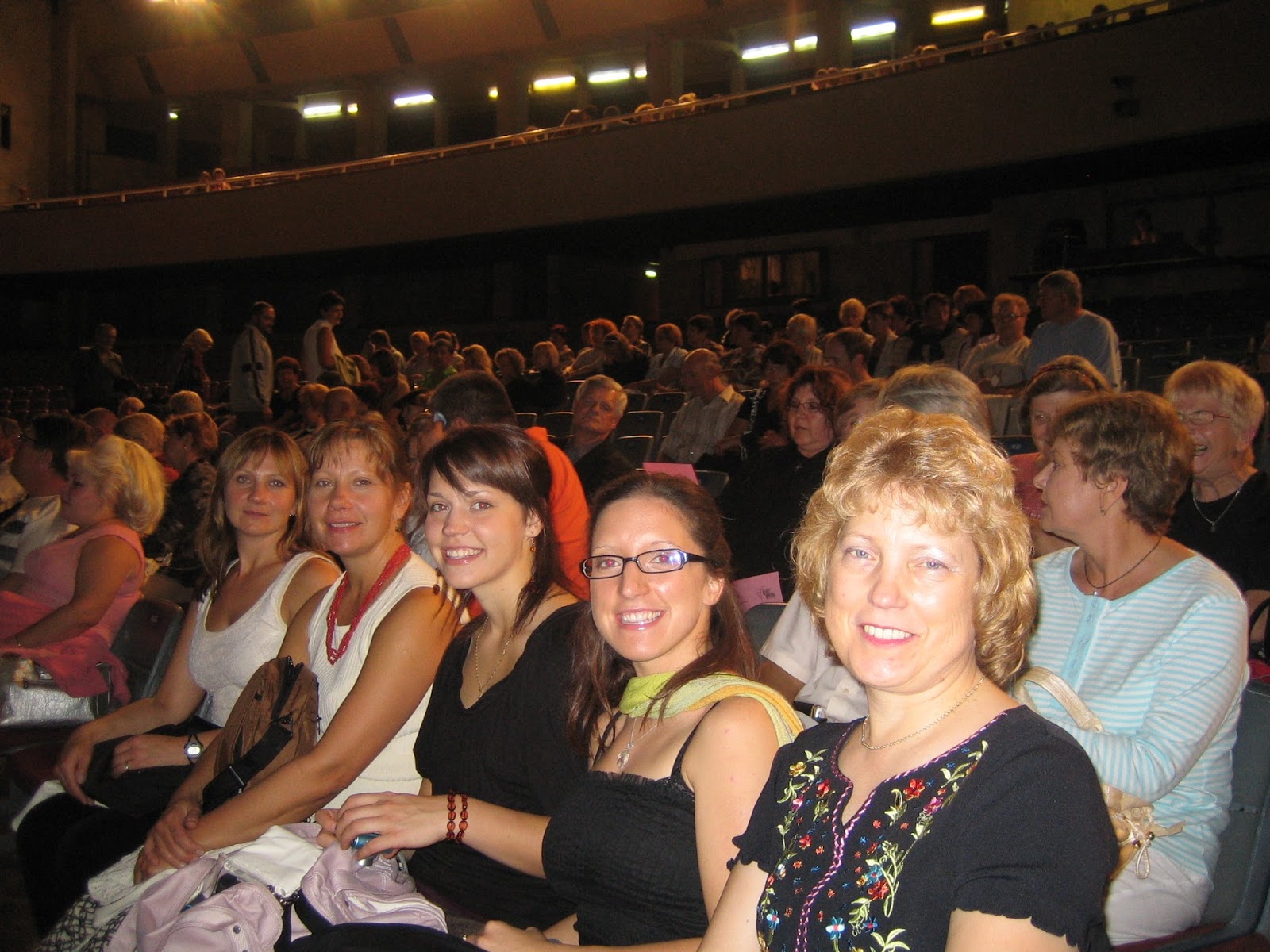 |
| Inside the ballet theatre in Yalta. |
 |
| Dinner in the Yalta Hotel. Photo op requested by fellow tourist (local). |
 |
| On our way from Yalta to Simferopol, where we caught the train to Lviv, we stopped in the town of Bakchissaray for lunch and a tour of a Crimean Tatar palace. Very different from the palaces in Yalta. |


 |
| Lunch in Bakchissaray was delicious. Everything was new and unusual so I put down my camera to concentrate! However I did have the presence of mind to take a picture of this dessert. It was light, crispy and melt-in-your-mouth. Reminded me of a giant ball of khrustyky! |
 | |
| Getting provisions for 25-hour train trip from Simferopol to Lviv-Sept2008. |
 |
| On the way to the train station in Simferopol. Don't imagine any Golden Arches there now. |
 |
| Train station in Simferopol. Hope one day to revisit. |
Monday, June 29, 2015
Kyiv air video
I can't take credit for this video (found it on YouTube) but thought I would share it with you.
It's extremely well done, and the visuals are gorgeous.
If you've been to Kyiv you will recognize some of the sights, as I certainly did.
If you haven't yet, then they may just make you think about taking a visit to this amazing and beautiful city.
Enjoy!
It's extremely well done, and the visuals are gorgeous.
If you've been to Kyiv you will recognize some of the sights, as I certainly did.
If you haven't yet, then they may just make you think about taking a visit to this amazing and beautiful city.
Enjoy!
Subscribe to:
Posts (Atom)
Featured Post
Ukrainian Food Flair became a best seller today!
So thrilled to see this today! Thank you to my dear friend and writing mentor, Marsha Forchuk Skrypuch , and best-selling children's a...
